Hey there.
This is part 2 of my Aruba 8360 basic and VSX configuration.
In this part, I want to go through the VSX and LAG/LACP configuration. I said I would do the configuration on the physical device. This turned out to be a bit of a hassle since there are a few parts still missing. So here I will do everything in the simulation. The configuration steps are identical. The only difference is that the Software Version will say “virtual”.
In Part 1 the configuration was the same on all 4 switches. Considering the project, there would be a few differences, like the uplinks to the access switches from the aggregation switches. But this won’t matter for the guide. Most of what I am showing here is only a representation and not the actual project. Since there is not really any difference in the actual configuration steps.
I will probably add a couple more parts to this series, once I actually deploy the devices, including the Aruba 2930F switches and the Aruba APs.
First I would want to connect the MGMT interface from the actual devices to our office network since I have to configure multiple devices for the VSX configuration. This will make it easier.
Default on ArubaOS-CX switches is DHCP for the MGMT interfaces, but I want to set it to a static IP in our network. I will start with the aggregation switches.
A closeup of the topology.
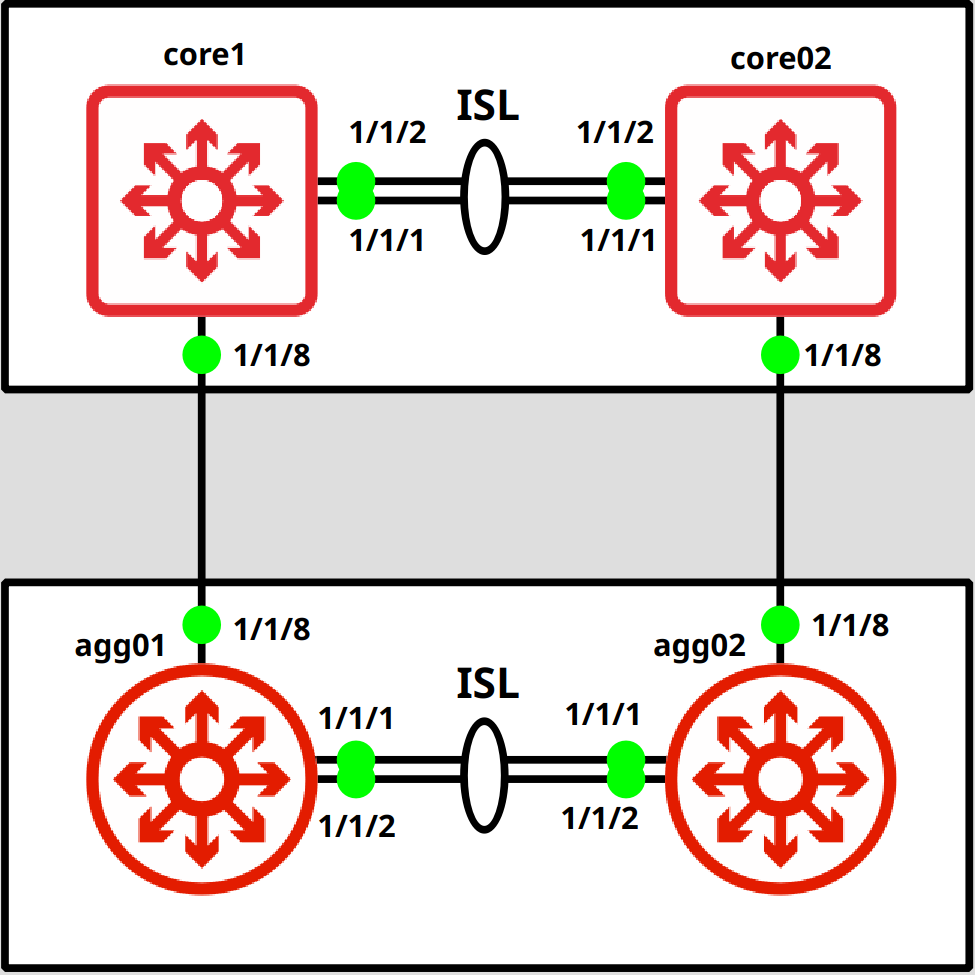
Let’s begin.
MGMT configuration
agg01# config
agg01(config)# interface mgmt
agg01(config-if-mgmt)# ip static 172.16.40.100/24

// If you want to change it back to DHCP
agg01(config-if-mgmt)# ip dhcp
agg01(config-if-mgmt)# exit
SSH connection
Now we can connect via SSH.
$ ssh admin@172.16.40.100
VSX preparation
Ok, now we can start with the VSX configuration.
I will start with the LAG interface. I tend to set the LAG for the ISL on a higher number (128 in this case). But this is not required.
agg01(config)# interface lag 128
agg01(config-lag-if)# no routing
agg01(config-lag-if)# no shutdown
agg01(config-lag-if)# lacp mode active
agg01(config-lag-if)# vlan trunk native 1
agg01(config-lag-if)# exit
Next, we will configure and assign the interfaces to the LAG.
agg01(config)# interface 1/1/1,1/1/2
agg01(config-if-<1/1/1,1/1/2>)# lag 128
agg01(config-if-<1/1/1,1/1/2>)# mtu 9198
agg01(config-if-<1/1/1,1/1/2>)# no shutdown
agg01(config-if-<1/1/1,1/1/2>)# exit
I will configure an SVI for the VLAN 999 and a separate VRF (the VRF is also not required but recommended) for the heartbeat/keepalive setting in VSX. The best practice would be to set up a dedicated L3 interface for this. But that’s not an option in this project.
// Create the VRF
agg01(config)# vrf KEEPALIVE
agg01(config-vrf)# exit

// Create the VLAN for the keepalive/hearbeat and attach it to the VRF
agg01(config)# vlan 999
agg01(config-vlan-999)# name KEEPALIVE
agg01(config-vlan-999)# exit

agg01(config)# interface vlan 999
agg01(config-if-vlan)# vrf attach KEEPALIVE
agg01(config-if-vlan)# ip address 10.99.99.1/30
The second switch has the exact same configuration, the only difference is the IP address for the keepalive VLAN 999
VSX configuration
That is it for the preparation. It’s time for the VSX configuration.
One of the recommended settings is the “system-mac”. For this, you should use one of the locally administered address ranges. These are.:
x2-xx-xx-xx-xx-xx
x6-xx-xx-xx-xx-xx
xA-xx-xx-xx-xx-xx
xE-xx-xx-xx-xx-xx
The idea behind this is, to have an independent system-mac from the hardware mac of the device. This allows smoother hardware replacements in case one of the devices fails since you can just use the same configuration as the previous device without any impact on the VSX.
Let’s continue with the configuration.
// Aggregation Switch 1
agg01(config)# vsx
agg01(config-vsx)# system-mac 0A:01:00:00:01:00
agg01(config-vsx)# inter-switch-link lag 128
agg01(config-vsx)# keepalive peer 10.99.99.2 source 10.99.99.1 vrf KEEPALIVE
agg01(config-vsx)# role primary
agg01(config-vsx)# vsx-sync mclag-interfaces neighbor ospf snmp ssh static-routes stp-global vrrp vsx-global
Do the same on the secondary switch. You only have to set the “vsx-sync” on the primary switch.
// Aggregation Switch 2
agg02(config)# vsx
agg02(config-vsx)# system-mac 0A:01:00:00:01:00
agg02(config-vsx)# inter-switch-link lag 128
agg02(config-vsx)# keepalive peer 10.99.99.1 source 10.99.99.2 vrf KEEPALIVE
agg02(config-vsx)# role secondary
agg02(config-vsx)# exit
Once that’s done, the VSX Cluster should work. Let’s check that. (this is an output from the Simulation since the MPO cables didn’t arrive in time).
agg01(config)# show vsx status
VSX Operational State
---------------------
  ISL channel             : In-Sync
  ISL mgmt channel        : operational
  Config Sync Status      : In-Sync
  NAE                     : peer_reachable
  HTTPS Server            : peer_reachable

Attribute           Local               Peer
------------ -------- --------
ISL link            lag128              lag128
ISL version         2                   2
System MAC          0a:01:00:00:01:00   0a:01:00:00:01:00
Platform            X86-64              X86-64
Software Version    Virtual.10.08.0001  Virtual.10.08.0001
Device Role         primary             secondary

agg01(config)# show vsx brief
ISL State                              : In-Sync
Device State                           : Peer-Established
Keepalive State                        : Keepalive-Established
Device Role                            : Primary
Number of Multi-chassis LAG interfaces : 0
We can see that everything is reachable and that the switches are in an “In-Sync” state.
Multi-chassis LAG/LACP configuration
Ok, now we will create a LAG/LACP interface, that stretches over both switches in a VSX (MC-LAG). The steps are basically the same as with a single switch. the only difference is in the very first command. Do not forget this step, since you cannot convert a “normal” LAG into a multi-chassis LAG. You would have to remove and recreate it.
// Aggregation Switch 1
agg01(config)# interface lag 1 multi-chassis
agg01(config-lag-if)# no routing
agg01(config-lag-if)# no shutdown
agg01(config-lag-if)# lacp mode active
agg01(config-lag-if)# vlan trunk native 1
agg01(config-lag-if)# description UPLINK-core01.P1/1/8
agg01(config-lag-if)# exit
Add the interface.
// Aggregation Switch 1
agg01(config)# interface 1/1/8
agg01(config-if)# lag 1
agg01(config-if)# no shutdown
agg01(config-if)# description LAG1-UPLINK-core01.P1/1/8
agg01(config-if)# exit
Here is the configuration for the second switch.
// Aggregation Switch 2
agg02(config)# interface lag 1 multi-chassis
agg02(config-lag-if)# no routing
agg02(config-lag-if)# no shutdown
agg02(config-lag-if)# lacp mode active
agg02(config-lag-if)# vlan trunk native 1
agg02(config-lag-if)# description UPLINK-core02.P1/1/8
agg02(config-lag-if)# exit
// Aggregation Switch 2
agg02(config)# interface 1/1/8
agg02(config-if)# lag 1
agg02(config-if)# no shutdown
agg02(config-if)# description LAG1-UPLINK-core02.P1/1/8
agg02(config-if)# exit
That’s it for the multi-chassis LAG configuration. Let’s check if everything is working.
Again this is from a simulation but the output is identical.
agg01(config)# show lacp interfaces
State abbreviations :
A - Active        P - Passive      F - Aggregable I - Individual
S - Short-timeout L - Long-timeout N - InSync     O - OutofSync
C - Collecting    D - Distributing
X - State m/c expired              E - Default neighbor state

Actor details of all interfaces:
----------------------------------------------------------------------------------
Intf       Aggr       Port  Port  State   System-ID         System Aggr Forwarding
           Name       Id    Pri                             Pri    Key  State
----------------------------------------------------------------------------------
1/1/8      lag1(mc)   8     1     ALFNCD  0a:01:00:00:01:00 65534  1    up
1/1/1      lag128     2     1     ALFNCD  08:00:09:05:66:9a 65534  128  up
1/1/2      lag128     3     1     ALFNCD  08:00:09:05:66:9a 65534  128  up

Partner details of all interfaces:
----------------------------------------------------------------------------------
Intf       Aggr       Port  Port  State   System-ID         System Aggr
           Name       Id    Pri                             Pri    Key
----------------------------------------------------------------------------------
1/1/8      lag1(mc)   8     1     ALFNCD  08:00:09:3d:5c:7b 65534  10
1/1/1      lag128     2     1     ALFNCD  08:00:09:74:42:09 65534  128
1/1/2      lag128     3     1     ALFNCD  08:00:09:74:42:09 65534  128
You can check the secondary switch with this command. The output looks basically the same.
agg01(config)# show lacp interface vsx-peer
A few more useful “show” commands.
agg01(config)# show lacp aggregates

Aggregate name   : lag1 (multi-chassis)
Interfaces       : 1/1/8
Peer interfaces  : 1/1/8
Heartbeat rate   : Slow
Hash             : l3-src-dst
Aggregate mode   : Active

Aggregate name   : lag128
Interfaces       : 1/1/1 1/1/2
Heartbeat rate   : Slow
Hash             : l3-src-dst
Aggregate mode   : Active
agg01(config)# show lag brief
-----------------------------------------------------------------------
LAG     Type               Aggregate  Mode    Enabled  Status   Speed
Name                       Mode                                 (Mb/s)
-----------------------------------------------------------------------
lag1    multi-chassis      active     trunk   yes      up       1000
lag128  inter-switch-link  active     trunk   yes      up       2000
VLAN VSX synchronization
A small “bonus” entry. :-) Would be pointless to create a separate post for this.
VSX acts more like a cluster than a stack, which means we have two separate management planes. This does not mean that we have to make every change on both switches though. You probably saw earlier that we enabled synchronization for protocols like OSPF or VRRP (See “VSX configuration” of the first switch). Here is a picture taken from an Aruba Document, comparing the traditional stack to VSX to make it a bit clearer.
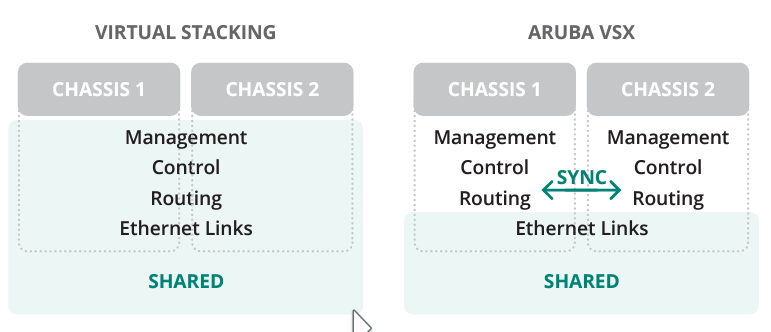
https://www.arubanetworks.com/resource/aruba-virtual-switching-extension-vsx/
You might also have noticed that there is no global option for VLAN synchronization.
There is a different way for this. Here is an example.
// Aggregation Switch 1
agg01(config)# vlan 100
// this will sync it to the second switch
agg01(config-vlan-100)# vsx-sync
agg01(config-vlan-100)# exit
You can see that the VLANs with the “vsx-sync” setting are synced to the secondary device (red), but VLANs 15 and 20 are only on the primary (green) and 30, 35 only on the secondary (purple).
// Aggregation Switch 1
agg01(config)# show running-config
...
vlan 1,10,15,20
vlan 25
    vsx-sync
vlan 100
    vsx-sync
vlan 999
spanning-tree
...
// Aggregation Switch 2
agg02(config)# show running-config
...
vlan 1,10
vlan 25
    vsx-sync
vlan 30,35
vlan 100
    vsx-sync
vlan 999
...
Below I will attach the configuration of every switch shown in the topology, in case you want to build it yourself.
In the next part, I will go through the configuration of the Aruba 2930F switches including VSF Stacking and Device Profiles for the Aruba APs.
Till next time.
AGG01
hostname agg01
led locator on
vrf KEEPALIVE
!
!
!
!
!
!
ssh server vrf mgmt
vlan 1-2
vlan 10
name SERVER
vsx-sync
vlan 20
name CLIENT
vsx-sync
vlan 30
name MGMT
vsx-sync
vlan 40
name VOIP
vsx-sync
vlan 50
vsx-sync
vlan 60
vsx-sync
vlan 70
vsx-sync
vlan 999
spanning-tree
spanning-tree priority 3
spanning-tree config-name STP
spanning-tree config-revision 1
interface mgmt
no shutdown
ip dhcp
interface lag 1 multi-chassis
no shutdown
description UPLINK-core01.P1/1/8
no routing
vlan trunk native 1
vlan trunk allowed all
lacp mode active
interface lag 128
no shutdown
no routing
vlan trunk native 1
vlan trunk allowed all
lacp mode active
interface 1/1/1
no shutdown
mtu 9198
lag 128
interface 1/1/2
no shutdown
mtu 9198
lag 128
interface 1/1/8
no shutdown
lag 1
interface vlan 999
vrf attach KEEPALIVE
ip mtu 9198
ip address 192.168.99.1/30
vsx
system-mac 0a:01:00:00:01:00
inter-switch-link lag 128
role primary
keepalive peer 192.168.99.2 source 192.168.99.1 vrf KEEPALIVE
vsx-sync dhcp-server mclag-interfaces neighbor ospf snmp ssh static-routes stp-global vrrp vsx-global
!
!
!
!
!
https-server vrf mgmt
AGG02
hostname agg02
led locator on
vrf KEEPALIVE
!
!
!
!
!
!
ssh server vrf mgmt
vlan 1
vlan 10
name SERVER
vsx-sync
vlan 20
name CLIENT
vsx-sync
vlan 30
name MGMT
vsx-sync
vlan 35
vlan 40
name VOIP
vsx-sync
vlan 50
vsx-sync
vlan 60
vsx-sync
vlan 70
vsx-sync
vlan 999
spanning-tree
spanning-tree priority 3
spanning-tree config-name STP
spanning-tree config-revision 1
interface mgmt
no shutdown
ip dhcp
interface lag 1 multi-chassis
no shutdown
description UPLINK-core02.P1/1/8
no routing
vlan trunk native 1
vlan trunk allowed all
lacp mode active
interface lag 128
no shutdown
no routing
vlan trunk native 1
vlan trunk allowed all
lacp mode active
interface 1/1/1
no shutdown
mtu 9198
lag 128
interface 1/1/2
no shutdown
mtu 9198
lag 128
interface 1/1/8
no shutdown
lag 1
interface vlan 999
vrf attach KEEPALIVE
ip address 192.168.99.2/30
vsx
system-mac 0a:01:00:00:01:00
inter-switch-link lag 128
role secondary
keepalive peer 192.168.99.1 source 192.168.99.2 vrf KEEPALIVE
vsx-sync dhcp-server mclag-interfaces neighbor ospf snmp ssh static-routes stp-global vrrp vsx-global
!
!
!
!
!
https-server vrf mgmt
CORE01
hostname core01
led locator on
vrf KEEPALIVE
!
!
!
!
!
ssh server vrf default
ssh server vrf mgmt
vlan 1-2
vlan 10
name SERVER
vsx-sync
vlan 20
name CLIENT
vsx-sync
vlan 30
name MGMT
vsx-sync
vlan 40
name VOIP
vsx-sync
vlan 50
vsx-sync
vlan 60
vsx-sync
vlan 70
vsx-sync
vlan 999
name KEEPALIVE
spanning-tree
spanning-tree priority 2
spanning-tree config-name STP
spanning-tree config-revision 1
interface mgmt
no shutdown
ip dhcp
interface lag 1 multi-chassis
no shutdown
description UPLINK-agg01.P1/1/8
no routing
vlan trunk native 1
vlan trunk allowed all
lacp mode active
interface lag 128
no shutdown
no routing
vlan trunk native 1
vlan trunk allowed all
lacp mode active
interface 1/1/1
no shutdown
mtu 9198
lag 128
interface 1/1/2
no shutdown
mtu 9198
lag 128
interface 1/1/8
no shutdown
description LAG1-UPLINK-agg01.P1/1/8
lag 1
interface 1/1/9
no shutdown
interface vlan 30
ip address 10.155.20.101/24
interface vlan 999
vrf attach KEEPALIVE
ip address 10.99.99.5/30
vsx
system-mac 0a:02:00:00:01:00
inter-switch-link lag 128
role primary
keepalive peer 10.99.99.6 source 10.99.99.5 vrf KEEPALIVE
vsx-sync dhcp-server mclag-interfaces neighbor ospf snmp ssh static-routes stp-global vrrp vsx-global
ip route 0.0.0.0/0 10.155.20.254
!
!
!
!
!
https-server vrf mgmt
CORE02
hostname core02
led locator on
vrf KEEPALIVE
!
!
!
!
!
ssh server vrf default
ssh server vrf mgmt
vlan 1
vlan 10
name SERVER
vsx-sync
vlan 20
name CLIENT
vsx-sync
vlan 30
name MGMT
vsx-sync
vlan 40
name VOIP
vsx-sync
vlan 50
vsx-sync
vlan 60
vsx-sync
vlan 70
vsx-sync
vlan 999
spanning-tree
spanning-tree priority 2
spanning-tree config-name STP
spanning-tree config-revision 1
interface mgmt
no shutdown
ip dhcp
interface lag 1 multi-chassis
no shutdown
description UPLINK-agg02.P1/1/8
no routing
vlan trunk native 1
vlan trunk allowed all
lacp mode active
interface lag 128
no shutdown
no routing
vlan trunk native 1
vlan trunk allowed all
lacp mode active
interface 1/1/1
no shutdown
mtu 9198
lag 128
interface 1/1/2
no shutdown
mtu 9198
lag 128
interface 1/1/8
no shutdown
description LAG1-UPLINK-agg02.P1/1/8
lag 1
interface vlan 999
vrf attach KEEPALIVE
ip address 10.99.99.6/30
vsx
system-mac 0a:02:00:00:01:00
inter-switch-link lag 128
role secondary
keepalive peer 10.99.99.5 source 10.99.99.6 vrf KEEPALIVE
vsx-sync dhcp-server mclag-interfaces neighbor ospf snmp ssh static-routes stp-global vrrp vsx-global
ip route 0.0.0.0/0 10.155.20.254
!
!
!
!
!
https-server vrf mgmt
Links:
Comments